
Laundry is one of those household jobs that never really stops. And for many Kiwi homes, the question isn’t just about which machine cleans better. It’s about what actually fits their homes, the budget, and the way the household runs day to day.
Should you buy a washer dryer combo?
Stick with a separate washing machine and dryer?
Or are there times when neither option is really the right answer?
This guide breaks down both setups honestly, covers who each one suits, and explains when skipping the appliance decision altogether and using a local laundry service near you makes more practical sense.
Quick Answers:
- A washer dryer is one machine that both washes and dries. They’re ideal for smaller homes with limited space.
- Separate machines suit larger households, high-volume laundry days, and bulky loads like duvets and bedding.
- Washer dryer combos typically dry about half the load they can wash, so large families will find them limiting.
- For oversized or one-off loads, a local laundromat with commercial-sized machines is often faster and more cost-effective than upgrading home appliances.
- The right choice comes down to your household size, laundry habits, and how much space you’re working with.
What Is a Washer Dryer?
How a washer dryer combines washing and drying in one machine
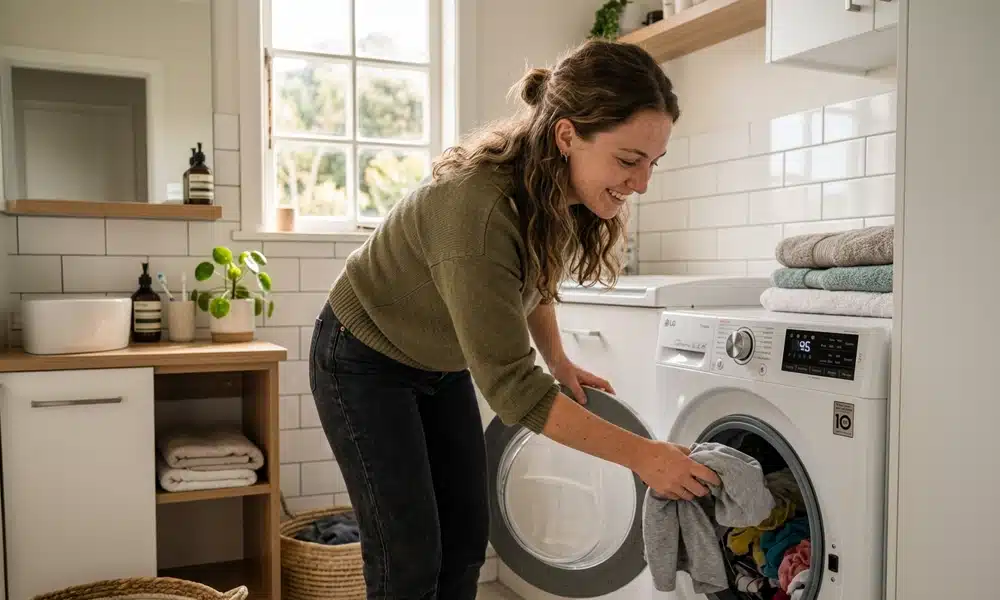
A washer dryer is a single front-loading appliance that handles both washing and drying in the same drum. You load your clothes once, set the cycle, and the machine washes and dries without you needing to do anything in between.
Most models use a condenser drying system. This means they don’t need an external vent and can be installed anywhere with a water connection and power outlet.
Why washer dryers appeal to smaller homes and tighter spaces
For Auckland apartments, units, or homes with a small laundry nook, fitting two separate appliances simply isn’t always possible. A washer dryer takes up the footprint of a single machine while doing both jobs. That’s the main draw: practicality.
How a washer dryer differs from a separate washing machine and dryer
The biggest difference is capacity. Most washer dryers can wash a full load, but only dry about half of it efficiently. So, if you wash 8kg of clothes, you may need to dry them in two separate drying cycles.
A separate washing machine and dryer avoid this entirely. You can wash one load while drying another, which makes a significant difference when laundry is piling up.
Washer Dryer vs Separate Machines: The Main Differences
Space and layout requirements
If you’re tight on space in your laundry area, a washer dryer is perfect. One machine, one power outlet, one water connection. Separate machines need either side-by-side placement or a stacking kit with enough overhead clearance.
Load size and household capacity
This is where separate machines pull ahead. A standard front-loading washing machine handles 8–12kg loads comfortably. A standalone dryer matches that capacity. With a washer dryer combo, drying capacity is typically just over half the wash capacity, so larger loads need to be split.
Convenience and day-to-day use
Washer dryers win on convenience for smaller households. Load once, walk away. But for homes doing multiple loads a day, separate machines are faster overall because washing and drying happen simultaneously rather than one after the other.
Drying time and workflow
Combined wash-and-dry cycles on a combo machine can run anywhere from three to five hours. Separate machines typically finish a wash in under an hour and a drying cycle in 45 to 60 minutes. For busy households, that time difference adds up quickly.
When a Washer Dryer Makes More Sense
Small homes, apartments, and limited laundry space
If you’re in a one- or two-bedroom apartment in Auckland with a compact laundry or bathroom, a washer dryer is often the only realistic option. It fits the space a single machine would take and removes the need to choose between a washer and a dryer.
Households that want one machine instead of two
Some people simply prefer less appliance clutter. Fewer machines means fewer things to maintain, fewer power connections, and a simpler laundry setup overall. For people who value simplicity over volume, the combo approach works well.
People who do smaller, more regular loads
Consumer NZ notes that average wash loads in New Zealand are around 4kg, which is well within what a washer dryer combo handles comfortably. If you’re washing smaller loads every few days rather than large loads once or twice a week, a combo machine keeps up without any real compromise.
When a Separate Washing Machine and Dryer Is the Better Choice
Larger families and frequent laundry days
A household with kids, sports gear, school uniforms, and bedding cycles through laundry fast.
Running multiple loads daily on a combo machine, where each full cycle takes three to five hours, quickly becomes a bottleneck. Separate machines let you run washing and drying simultaneously, cutting the overall time in half.
Homes that wash bulky items or heavy loads
Duvets, heavy towels, blankets, and king-sized bedding push most washer dryers to their limit. These items need more drum space and longer drying times than a combo can reliably provide. A full-sized dryer handles bulky loads far better.
Households that want more flexibility between washing and drying
With a washing machine and dryer set up separately, you’re not locked into one machine doing everything. You can wash a second load while the first is drying. If one appliance needs servicing, the other still works. That flexibility matters more as household size grows.
With a washing machine and dryer set up separately, you’re not locked into one machine doing everything. You can wash a second load while the first is drying. If one appliance needs servicing, the other still works. That flexibility matters more as household size grows.
The Real Pros and Cons of a Washer Dryer
Benefits of saving space and reducing appliance clutter
- One appliance to buy, one to maintain.
- Takes up the footprint of a single machine.
- Wash-to-dry in a single cycle with no manual transfer.
- No external venting needed. Can be installed in a bathroom, ensuite, or laundry nook.
Common trade-offs households should know about
- You can’t wash a second load while the first is drying.
- Drying capacity is typically around half of the washing capacity.
- Full wash-and-dry cycles take significantly longer than separate machines.
- Drying performance on combo units is generally weaker than that of a dedicated dryer.
Why your laundry habits matter more than the machine trend
A washer dryer isn’t better or worse than separate machines. It’s a different tool for a different household type. The honest question is whether your daily laundry volume suits a single-cycle machine or whether you need the throughput that only separate appliances provide.
Cost, Convenience, and Everyday Laundry Habits
Upfront appliance cost vs long-term practicality
NZ retail pages show washer dryer combos ranging from around $850 to $5,000 for premium models. Buying a washing machine and a dryer separately often costs more upfront, but gives you more flexibility to choose capacity, brand, and features independently.
How often do you actually wash and dry clothes?
Twice a week with small loads? A combo probably covers you. Daily loads for a family of five? You’ll likely find that a combo machine creates a backlog. Be honest about your actual laundry routine, not your ideal one.
Why the right choice depends on your household routine
If clothes go on the line most of the year and you only use a dryer in winter, a combo might make perfect sense. If the dryer runs daily, separate machines are likely the better long-term investment.
What About Bulky Loads, Blankets, and Family-Sized Washing?
Why home machines can struggle with oversized loads
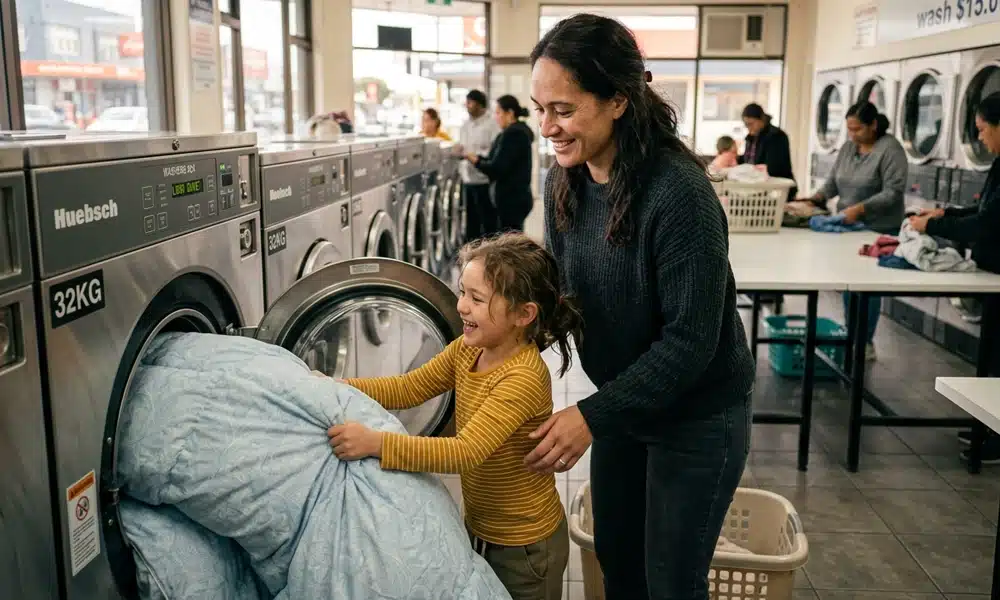
Most domestic washing machines and dryers have limits on what they can handle. King-sized duvets, heavy winter blankets, and multiple sets of bedding often exceed the drum size of standard home appliances, or take so long to dry that they come out still damp.
When capacity becomes more important than convenience
This is where the home appliance conversation hits a ceiling. Buying a larger machine to handle the occasional big wash is expensive. Using commercial-grade machines for those loads is almost always more practical.
Why some households still need a laundromat for large items
Even households with good home appliances regularly use a laundromat for duvets, bedding sets, and sports gear. The machine size, drying heat, and turnaround time that commercial laundry equipment offers simply can’t be matched at home.
When a Laundry Service Near You Is Better Than Buying Bigger Machines
One-off bulky loads and seasonal laundry
Winter duvets, summer sports gear, moving house, and post-renovation washing are situations where a one-off visit to a laundry service near you is necessary. It makes far more sense than running an undersized home machine three times or spending thousands on a larger appliance.
Busy households that need a faster turnaround
At Stoddard Road Laundromat in Mt Roskill, over 60 machines are available 24/7. This includes large- and extra-large capacity washers and dryers suited to heavy household loads. You can wash and dry a king-sized duvet in a single visit rather than waiting through multiple home machine cycles.
How a local laundry service can reduce home machine pressure
Using a laundromat for bulky or high-volume loads every few weeks takes the pressure off your home machine and extends its life. It’s not an either/or; plenty of Auckland households run their everyday clothes at home and bring the big stuff to a laundromat.
Why Laundromats Still Matter for Modern Households
Faster washing and drying with larger machines
Commercial laundromat machines run at higher capacities and faster cycles than domestic appliances. A load that takes your home machine two hours to wash and dry can often be done in under an hour at a laundromat.
Better support for duvets, bedding, and oversized items
Stoddard Road Laundromat handles blankets, duvets, sheets, sports gear, and towels regularly. The machine range covers small through to extra-large loads, with staff on site 24/7 to help if you’re not sure which machine size to use.
Why 24/7 laundromat access helps busy Auckland households
Not everyone can get laundry done during business hours. Having a fully attended laundromat open around the clock in Mt Roskill means you’re not working around someone else’s schedule. Early morning, late at night, or on a public holiday, our machines are available when you need them.
Need to get through a big load without the wait? Visit us at 220 Stoddard Road, Mt Roskill, or call (09) 629 5117. We’re open 24/7. Enquire Now
How to Decide What Works Best for Your Household
Questions to ask before buying a washer dryer
- Do I have space for two machines, or am I limited to one?
- Are my typical loads under 4–5kg?
- Am I comfortable with longer cycle times in exchange for convenience?
- Do I rarely need to dry bulky items at home?
Questions to ask before buying separate machines
- Do I run multiple loads per week regularly?
- Do I wash duvets, heavy towels, or large family loads?
- Do I have space to stack or place two machines side by side?
- Would the flexibility of washing and drying simultaneously make a difference?
When does using both home appliances and a laundromat give the best result?
For most households, the answer isn’t one or the other. A washer dryer or separate machines handle the day-to-day. A local laundromat covers the big, bulky, or time-sensitive loads that home appliances weren’t really built for.
That combination, home machine for everyday laundry, laundromat for the rest, is how a lot of Auckland households already run things, even if they don’t think of it that way.
FAQs About Washer Dryer vs Separate Machines
Is a washer dryer worth it in New Zealand?
For smaller households in compact homes or apartments, yes. A washer dryer covers most everyday laundry needs without taking up the space of two appliances. For larger families or anyone doing heavy loads regularly, separate machines will serve you better.
Is a washing machine and dryer better than a washer dryer?
For performance and volume, separate machines generally come out ahead. You can run larger loads, wash and dry simultaneously, and choose appliances that match your capacity needs independently. The trade-off is space and upfront cost.
Which option is better for small homes?
A washer dryer is typically the more practical choice for small homes and apartments where space is the main constraint. Just be aware of the reduced drying capacity and longer cycle times before buying.
When should I search for a laundry service instead?
When you’re dealing with duvets, blankets, bulky bedding, or any load your home machine struggles to handle, a laundry service near you is usually the faster, more cost-effective option. It’s also worth considering if your home machine is out of action or if you need a large amount of laundry done quickly.
Are laundromats near you better for large loads?
Yes. Commercial laundromat machines handle larger capacities at faster cycle times than most home appliances. For duvets, heavy towels, sports gear, and family-sized bedding, laundromats near you are often the most practical option.
